WASHINGTON PREDATOR-PREY PROJECT
  • Overview
  • Research Topics
    • Community Dynamics
    • Wolf-Cougar Interactions
    • Carnivore-Ungulate Interactions
    • Mesopredators
  • Products
  • Outreach
  • Media
    • WPPP in the news
    • Updates from the field (blog)
  • People
  • Partners

UPDATES FROM THE FIELD

How to Catch a Mountain Lion

11/7/2018

6 Comments

 
​January 2018 brought a new season of cougar captures for the Wolf-Cougar Project. When capturing cougars for research, winter is the best time to find these large felines. Snow makes tracking easier, and both cougars and the animals they eat congregate at lower elevations in valley bottoms to avoid the deep snow accumulating up high. Not to mention that a blanket of snow atop Washington’s conifer forests make for a scene worthy of a Bob Ross painting.
Picture
Okanogan study area in winter with snow on the North Cascades.
Picture
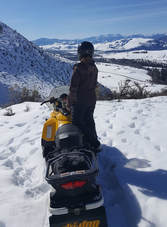
Lead technician Caitlin Kupar drives a snowmobile back to the trucks after a successful collaring effort.
We catch cougars using either box traps or with the help of local houndsmen and trained hounds. Box trapping allows us to capture cougars in areas with more roads and private lands, whereas hounds help us cover larger amounts of ground in National Forests. Of sixteen cougars captured in 2016/2017, six were still alive in 2018. Ten were no longer part of the study due to either collar failure or mortalities caused by hunter harvest, agency removals, starvation, being killed by other cougars, or unknown factors.

Why Cougars Die
Hunting, agency removals, disease, starvation, and intra-species conflict can result in death for cougars in this region. The cougar hunting season runs throughout the winter in Washington, Idaho, and Canada, with many cougars taken when hunters are out looking for deer or elk. Young cougars stay with their mothers until approximately 18 months of age, looking like full-grown adults before they disperse. These “teenage” cats, known as subadults, sometimes do not have the hunting skills needed to make it through their first year on their own, while other times they wander into the territories of adult cats. Subadult male cougars in particular can die in territorial disputes with other adult males. Our research will allow us to better understand the different causes of mortality for cougars in Washington, and how a growing wolf population might be impacting cougar survival.
​
Cougar Collaring
Our goal for last winter was to deploy at least twelve more collars across our two study regions to help us understand how these large cats interact with wolves, the other large predator in the region. A typical winter day starts out by warming up snowmobiles and donning enough layers for a full day outdoors. Last winter, temperatures were markedly warmer, with most days around 30F instead of the frigid temps during the winter of 2016-2017 which could reach -15F. We do not capture cougars in temperatures below 5F, but we’re often out in colder temperatures looking for tracks and making plans for warmer days!
Picture
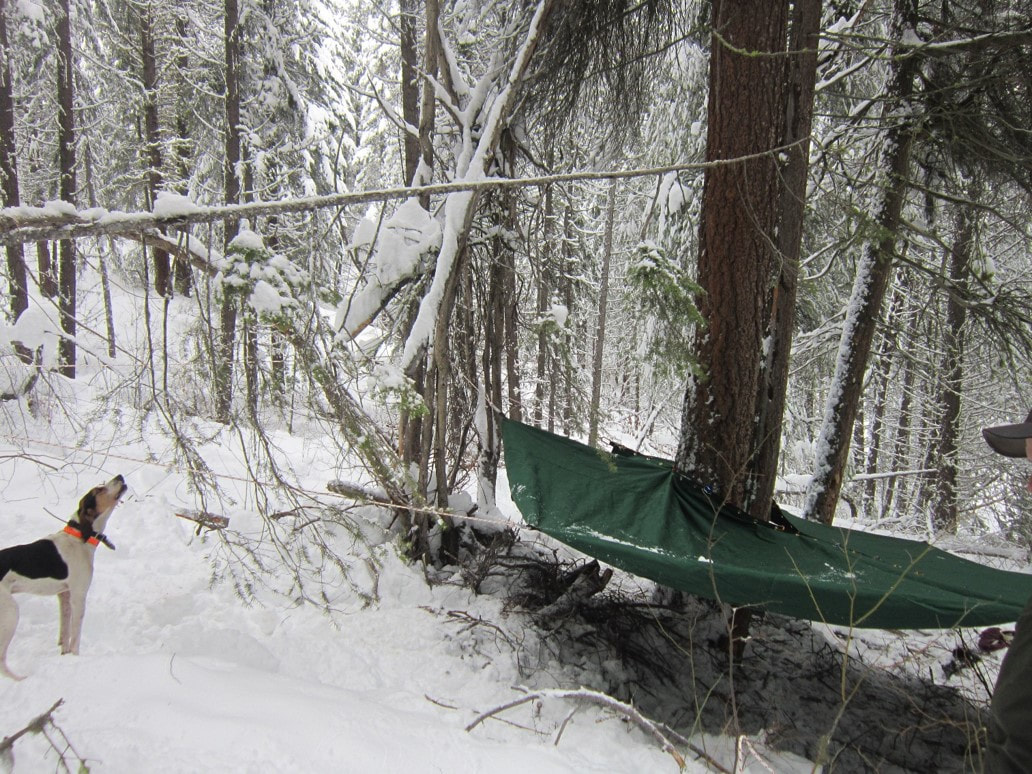
Safety net set up below a treed cougar (Photo: Caitlin Kupar).
Picture
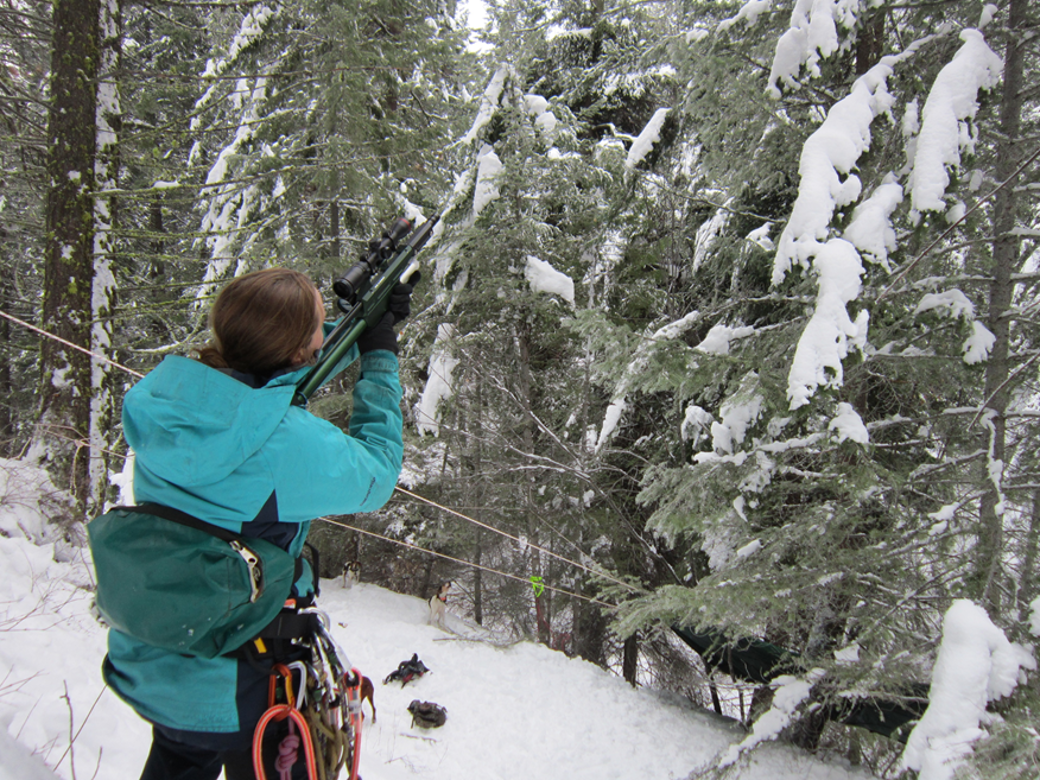
Lauren Satterfield preparing to dart (Photo: Caitlin Kupar).
Picture
Climbing to the anesthetized cougar (Photo: Caitlin Kupar).
Cougars often walk down roads or cross them, so we spend the bulk of each capture day searching roads for fresh tracks. When we find tracks, we want to make the chase as short as possible for both the cougars and the hounds. We do as much of the work as we can ourselves, following tracks to see if they cross another road farther on or circle back on themselves, before letting the four-legged canine experts on the trail. 

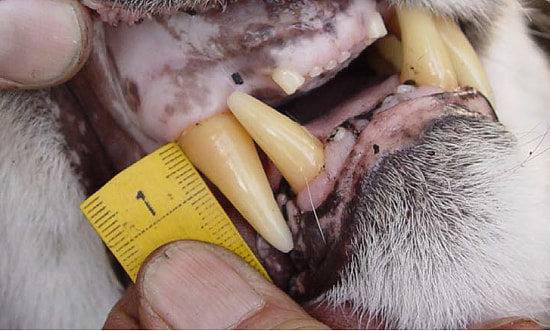
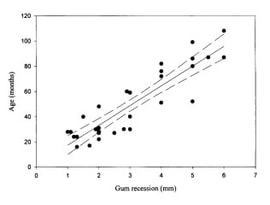
​Once a cougar climbs up a tree we move the pursuing hounds back, set up a safety net to catch a potential fall, dart the animal with an anesthetic, and climb up the tree to lower the anesthetized cat to the ground. We weigh the cougar and then estimate its age based on a method called gumline recession. Older animals have a larger gap between the gum and where the canine tooth begins to taper.
Picture
A cougar with a 3mm gumline recession (flat part before the canine tooth starts to taper to a point) (Photo: Rich Beausoleil).
Picture
Older cougars have larger gumline recession (Graph: Laundre et al. 2000).
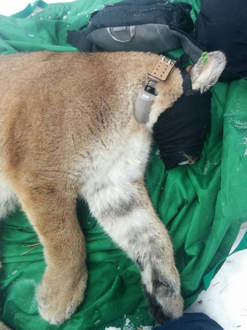
Then, we affix small ear tags with an identification number to each ear and attach a global positioning system (GPS) collar that will allow us to track the animal for two to three years. After approximately 45 minutes, the cougar slowly begins to wake up and we leave. We surpassed our goal and put out seventeen new collars last winter, bringing our total to thirty-three cougars collared so far!
In this post, I’ve referred to these cats as “mountain lions” and “cougars”. Both terms refer to the same species, Puma concolor. Depending on which part of the country or world you are in, the species Puma concolor may be referred to as a mountain lion, cougar, puma, lion, panther, or catamount.

Note: If you harvest a cougar (or deer or elk or coyote or bobcat) with a GPS collar, please use a wrench or pliers to remove the bolts on the side of the collar. Please do not cut the collar off with a knife, as this can keep us from being able to reuse it on another animal, and could damage electronic components. Collars should have a metal plate with a phone number to call, or can be turned in when the animal is sealed. 

- Lauren Satterfield
Picture
Subadult cougar with new ear tags and GPS collar. Notice the black arm bars on the inside of the front left leg, typical of an animal of one to two years of age. In some cases, bars persist into the third year. The black mask keeps snow and debris from getting into the cougar’s eyes, and increases comfort by ensuring a dark environment while it is under anesthesia.
6 Comments
An
10/26/2020 11:00:36 am

There is a cougar in our town, currently in a natural area bound by W. Mercer way, a downtown park. and a lot of residences. This is not a large area and once the racoons are picked off preschoolers could be endangered. Can you trap it?

Reply
Lauren
10/26/2020 01:25:57 pm

Hi An! If you would like to report a cougar sighting, the appropriate party to contact is the Washington Department of Fish and Wildlife (WDFW). You can call them at 877-933-9847 or file an online report by going to this webpage: https://wdfw.wa.gov/species-habitats/living/dangerous-wildlife/reports

Reply
Lauren
10/26/2020 01:30:50 pm

If you would like more information on cougars (also known as mountain lions) and living somewhere near their territories, the Washington Department of Fish and Wildlife (WDFW) has some great resources. Here is their most recent cougar information pamphlet:
https://wdfw.wa.gov/sites/default/files/2019-03/Cougar%20Brochure.pdf

anna link
11/19/2020 04:14:47 am

Both fun & fact to read. Looking forward to the next post!

Reply
Carson Reed link
6/23/2022 09:11:32 am

Niice blog thanks for posting

Reply
Lauren
6/23/2022 09:26:57 am

Thanks Carson! So glad you enjoyed it!

Reply


Leave a Reply.

    Archives

    October 2022
    February 2021
    June 2020
    January 2020
    October 2019
    August 2019
    April 2019
    January 2019
    November 2018
    October 2018
    August 2018

    Categories

    All

    RSS Feed

Powered by Create your own unique website with customizable templates.
  • Overview
  • Research Topics
    • Community Dynamics
    • Wolf-Cougar Interactions
    • Carnivore-Ungulate Interactions
    • Mesopredators
  • Products
  • Outreach
  • Media
    • WPPP in the news
    • Updates from the field (blog)
  • People
  • Partners