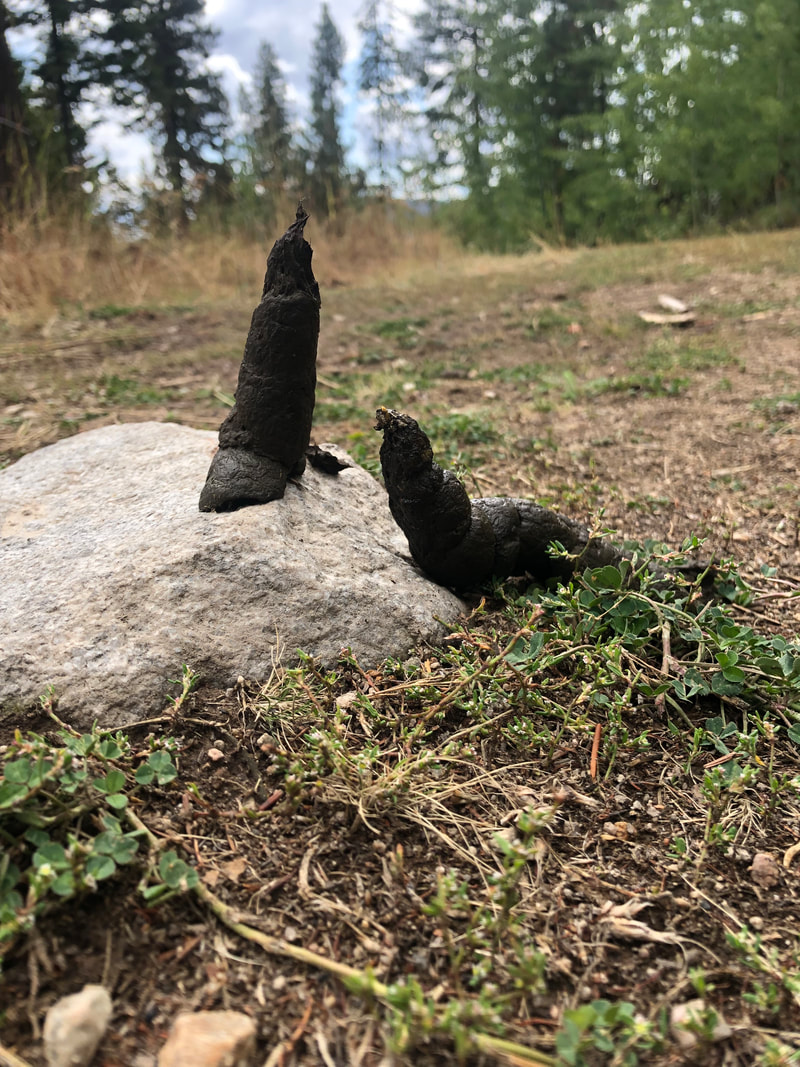
 A nice, fresh coyote scat. Morphological characteristics, such as the tapered ends on this scat, can be used to ID scats in the field. Photo Credit: Anna Machowicz A nice, fresh coyote scat. Morphological characteristics, such as the tapered ends on this scat, can be used to ID scats in the field. Photo Credit: Anna Machowicz The mesopredator portion of the WA Predator-Prey Project focuses on understanding the behaviors and population dynamics of coyotes and bobcats, the predominant middle-sized predators here in Washington. To study these animals we collect a wide variety of data. We deploy GPS collars on coyotes and bobcats to track their movements, place remote wildlife cameras on ungulate carcasses to document scavenging behaviors, and to measure population characteristics like density, we pick up a lot of poop. Yes, poop. Or scat, or feces, or excrement, or whatever you want to call it; doing poop science is an incredible, non-invasive way of tracking cryptic, wide-ranging species like carnivores. Here is how it works: When we find a scat, we know that an animal was there, in that exact location, at some recent point in time. We record the location of the scat with a GPS device and then do our best to identify it to a species level. Coyote? Bobcat? Wolf? Bear? Cougar? We look at both morphological characteristics – Size? Segmented Pieces? Tapered Ends? – and contents – Hair? Bones? Berries? Grass? – to help us make our determination of which species the scat belongs to. Some scats are easy to identify, but others can be quite challenging! Next, if the scat looks to be on the fresher side, we collect a genetic sample. The fresher a scat is, the higher the probability that we can successfully genotype the sample. However, we have been able to successfully genotype scats estimated to be a couple of months old, so we collect any scat that is still looking relatively fresh. Scat contents are made of waste materials that can be useful to assess the animal’s diet, but dead epithelial cells that line the gut and slough off on the outer surface of each poop are what we are after for genetics. These epithelial cells are collected by swabbing the surface of a scat and the DNA within the cells can then be used to tell us a whole bunch of things about the animal that pooped. In the lab, we use mitochondrial DNA within cells to check and make sure our field identification (ID) of species was correct. Mitochondrial DNA is inherited only from your mother and as a result, can be used to efficiently tell species apart. Our crews correctly identify scats 8 out of 10 times in the field – not too shabby! – but genetics allow us to confirm field IDs and fill in gaps when certainty is low or an ID is incorrect. After species identification is verified, we can find out exactly who took the poop by looking at animal’s nuclear DNA. This is possible because nuclear DNA comes from a unique combination of the animal’s parents, allowing us to tell individual animals apart. Species and individual identifications are extracted from swabbed DNA at the SEFS genetics lab at the University of Washington, where the individual identifications in turn allow us to make inferences about the population characteristics we are researching. 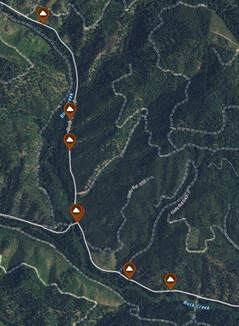 An important part of doing poop science is having good information about where and when you found each scat on the landscape. We use this information in combination with individual IDs from genetics to understand population dynamics. An important part of doing poop science is having good information about where and when you found each scat on the landscape. We use this information in combination with individual IDs from genetics to understand population dynamics. To make population inferences, we use results from genetic analyses (i.e., the individual IDs) in combination with the location of where we found each scat (i.e., spatial information). By finding multiple scats from the same individual across both space and time we can use models to get a basic idea of where each animal lives, and how many animals of each species reside in our area of interest.
Poop science (or fecal genotyping in scientific terms), along with other methods that capitalize on the non-invasive collection of animal DNA, are rapidly advancing and can be used in conjunction with a variety of models to study wildlife populations. In addition to doing poop science, the WA Predator-Prey project uses DNA to investigate a variety of questions (see the When Deer Die post!) and these genetic investigations are only a few of the extensive methods that are being used to investigate predator-prey interactions in Washington. - Becca Windell
2 Comments
Kathy espinosa
10/15/2020 05:35:08 pm
Please help. I am sending a picture of poop from just outside my garage. 4weeks ago my beloved pumpkin kitty disappeared. No dog anymore, my sweetiepie passed two weeks ago. A coyote? A cougar, bobcat? Im desperate. I foster unwanted kittys. There is a crisis in this county. If you can identify from picture it would be a great help.
Becca Windell
10/16/2020 11:54:02 am
Hi Kathy, Leave a Reply. |
 RSS Feed
